Are you a Central District resident? Do you have a (least) favorite vacant lot that you'd like to see converted to productive land? Alleycat Acres is looking for space in the CD to start their first garden; the bigger the plot the better. They have found available funding for this sort of project and just need a place to, literally, put down roots.
You can get in touch with Sean through Alleycat's website or leave a message with me, which I'll pass along.
Saturday, January 16, 2010

Sunday, January 3, 2010
Park(ing) Day and ARTSPARKS 2010
As you probably know, back in September we hosted the Park(ing) Day Central Park in conjunction with the Capitol Hill Community Council, which was funded in part by a smART Ventures grant from the city. A few weeks after the event, another similar grant was brought to my attention, so I applied, hoping to fund Park(ing) Day for 2010. Unfortunately, money is tight and we did not receive funding. In a way this is not a huge concern since we now have access to cheap insurance through Shunpike, but still the money would be helpful so we can offer increased programming (more music, bouncy castles, whatever). So if you know of any applicable grants for arts and community events, please let me know.
That brings me to 4Culture's ARTSPARKS project in Pioneer Square's Occidental Park. I first heard of this last summer when Free Sheep did their twenty-four hour Murakami performance. While PPL's focus thus far has been Capitol Hill, I've always found Pioneer Square to be romantic and underutilized, so it would be nice to do something for that neighborhood.
My first idea comes from a discussion I recently had with an urban planner from NYC: he spoke of the heavily curated flea markets (lots of good stuff, not much junk) that are evidently all the rage in the big city. I thought we could do something similar but maybe around a theme like, say, the impending loss of Elliott Bay Books. Borrowing from Free Sheep's twenty-four hour concept, and CHS's Capitol Hill Garage Sale last summer, I envision a twenty-four hour market that is centered on, well, books. Of course, we could expand it to include the cafe and hopefully some sort of performances for the wee hours of the morning, and to help attract a wider range of participants.
I'm going to get in touch with The New Pioneer Square and see if they'd be interested in tackling this (or another such) project. Let me know if you have any ideas or thoughts: one valid critique might be that looking backward is not the best way for Pioneer Square to proceed; that Elliott Bay is going and it's time to focus on something new. Anyhow, the deadline for proposals is March 12, so we still have some time.
That brings me to 4Culture's ARTSPARKS project in Pioneer Square's Occidental Park. I first heard of this last summer when Free Sheep did their twenty-four hour Murakami performance. While PPL's focus thus far has been Capitol Hill, I've always found Pioneer Square to be romantic and underutilized, so it would be nice to do something for that neighborhood.
My first idea comes from a discussion I recently had with an urban planner from NYC: he spoke of the heavily curated flea markets (lots of good stuff, not much junk) that are evidently all the rage in the big city. I thought we could do something similar but maybe around a theme like, say, the impending loss of Elliott Bay Books. Borrowing from Free Sheep's twenty-four hour concept, and CHS's Capitol Hill Garage Sale last summer, I envision a twenty-four hour market that is centered on, well, books. Of course, we could expand it to include the cafe and hopefully some sort of performances for the wee hours of the morning, and to help attract a wider range of participants.
I'm going to get in touch with The New Pioneer Square and see if they'd be interested in tackling this (or another such) project. Let me know if you have any ideas or thoughts: one valid critique might be that looking backward is not the best way for Pioneer Square to proceed; that Elliott Bay is going and it's time to focus on something new. Anyhow, the deadline for proposals is March 12, so we still have some time.
Thursday, December 31, 2009
NYE *update*
*Update*
Quote from the Facebook group: "I know that a few people are bringing more/better sparkly/boomy things to the lot around midnight." Check it out.
*Original post*
Someone over on the Facebook group suggested a bunch of folks with sparklers celebrate tonight at midnight on the lot. Any takers?
Quote from the Facebook group: "I know that a few people are bringing more/better sparkly/boomy things to the lot around midnight." Check it out.
*Original post*
Someone over on the Facebook group suggested a bunch of folks with sparklers celebrate tonight at midnight on the lot. Any takers?
Sunday, December 27, 2009
Canoe Social Club
Why did I just now hear about this place?
From their website:
Canoe Social Club provides a social gathering place for artists, arts supporters and science professionals in Seattle who want to:
* Empower and embolden the creative class
* Provide a forum for idea and resource exchange
* Be a hotbed for generative, creative solutions
* Provide gathering space for artists outside the typical mainstream bar culture
Canoe is also an event location for arts and sciences, social and administrative events, figure drawing sessions, culinary events, master classes, open mic nights, staged readings, fundraisers and First Thursday/ArtWalk.
It is a members only club (of which I am not a member, but may apply), with an application process and $20annual per month dues, both of which seem to be in place to maintain a certain level of seriousness. The rules are reasonable and revolve mostly around acting civilized. No throwing up, though (save that for The Ruins!).
Follow them on Twitter and be their friend on Facebook.
From their website:
Canoe Social Club provides a social gathering place for artists, arts supporters and science professionals in Seattle who want to:
* Empower and embolden the creative class
* Provide a forum for idea and resource exchange
* Be a hotbed for generative, creative solutions
* Provide gathering space for artists outside the typical mainstream bar culture
Canoe is also an event location for arts and sciences, social and administrative events, figure drawing sessions, culinary events, master classes, open mic nights, staged readings, fundraisers and First Thursday/ArtWalk.
It is a members only club (of which I am not a member, but may apply), with an application process and $20
Follow them on Twitter and be their friend on Facebook.
Wednesday, December 23, 2009
Alleycat Acres
I got an early Christmas present this year from Sean at Worldchanging: he sent an email with a link to his new urban farming project, Alleycat Acres. This soon-to-be collective has its sights set on transforming urban yards and vacant lots into productive land, to power these farms by bicycles, and to distribute their produce through sliding scale CSAs and farmers markets.
Sean is based in Ballard and is looking for co-conspirators/visionaries. You can find all the information and contact info over at Alleycat Acres' website and can also follow them on twitter.

[image from Alleycat Acres]
Sean is based in Ballard and is looking for co-conspirators/visionaries. You can find all the information and contact info over at Alleycat Acres' website and can also follow them on twitter.
[image from Alleycat Acres]
Tuesday, December 8, 2009
Mini Empire Bakery
I don't make a habit of plugging business ventures unless they are local and outstanding (Spine and Crown, Under Pressure Seltzer Works, etc). With that in mind, I'd like to introduce you to the Mini Empire Bakery, half-owned and operated by Morgan Greenseth, one of the organizers of the Park(ing) Day Central Park back in September. If you came by Park(ing) Day, you might have had a chance to sample one of her baked goods at the yoga and treat park she co-hosted.
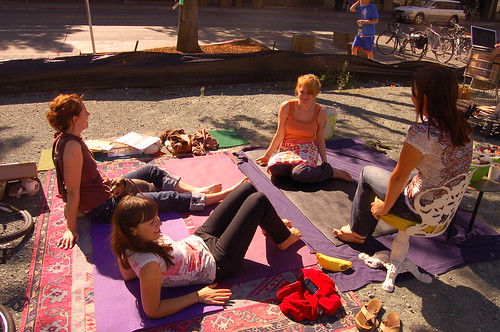
[Photo from the Worldchanging Flickr Set]
Just in time for the holidays!
[Photo from the Worldchanging Flickr Set]
Just in time for the holidays!
Sunday, December 6, 2009
Essay Proposal for UW Arch Journal, Column 5
The theme of this issue is Mind the Gap.
From Visual Consumption to Social Production
With regard to the built environment, the gap between the former use of a space and its future use is normally physically manifest as an empty space itself: a gap in the urban fabric. However, in the current economic situation, where formerly vibrant (or even formerly empty) spaces have been left as vacant lots, partially-demolished buildings, or open excavations, a new sort of vacant space has been created, a space in limbo between what it was and what it will (or might) be, at some indefinite point in the future. This space exists in the present – that perennial gap between the past and future – and the architect’s renderings for its destiny no longer represent a future project, but a formerly future, now uncertain project. Those confronted with such spaces daily – whether or not they previously used the spaces – read them in one way, while the owners, architects, and engineers likely see them differently. Lefebvre has given us the tools to interpret these spaces from both perspectives with his conceptions of lived and conceived space.
In response to these directly experienced gaps in the landscape, a number of groups have devoted themselves to reactivation campaigns. In Seattle, groups like the Free Sheep Foundation, SuttonBeresCuller, and the organizers of the Burien Interim Art Space (B /IAS) specialize in temporary art installations; a loose-knit group that I started (People’s Parking Lot) has also organized both a community garage sale and a day-long temporary art installation (Park(ing) Day) in one such space on Capitol Hill. Other groups, such as Rebar and raumlaborberlin, specialize in bringing unique social interaction to vacant, disused, and privately-owned public spaces. In my essay, I will investigate such spaces, introduce and apply Lefebvre’s conceptions to them, and present some unique cases where “bottom-up” activism has transformed the consumers of visual space (I’m borrowing here from the philosopher Edward Casey’s concept of visual acquisition) into producers of social space.
From Visual Consumption to Social Production
With regard to the built environment, the gap between the former use of a space and its future use is normally physically manifest as an empty space itself: a gap in the urban fabric. However, in the current economic situation, where formerly vibrant (or even formerly empty) spaces have been left as vacant lots, partially-demolished buildings, or open excavations, a new sort of vacant space has been created, a space in limbo between what it was and what it will (or might) be, at some indefinite point in the future. This space exists in the present – that perennial gap between the past and future – and the architect’s renderings for its destiny no longer represent a future project, but a formerly future, now uncertain project. Those confronted with such spaces daily – whether or not they previously used the spaces – read them in one way, while the owners, architects, and engineers likely see them differently. Lefebvre has given us the tools to interpret these spaces from both perspectives with his conceptions of lived and conceived space.
In response to these directly experienced gaps in the landscape, a number of groups have devoted themselves to reactivation campaigns. In Seattle, groups like the Free Sheep Foundation, SuttonBeresCuller, and the organizers of the Burien Interim Art Space (B /IAS) specialize in temporary art installations; a loose-knit group that I started (People’s Parking Lot) has also organized both a community garage sale and a day-long temporary art installation (Park(ing) Day) in one such space on Capitol Hill. Other groups, such as Rebar and raumlaborberlin, specialize in bringing unique social interaction to vacant, disused, and privately-owned public spaces. In my essay, I will investigate such spaces, introduce and apply Lefebvre’s conceptions to them, and present some unique cases where “bottom-up” activism has transformed the consumers of visual space (I’m borrowing here from the philosopher Edward Casey’s concept of visual acquisition) into producers of social space.
Subscribe to:
Posts (Atom)


